
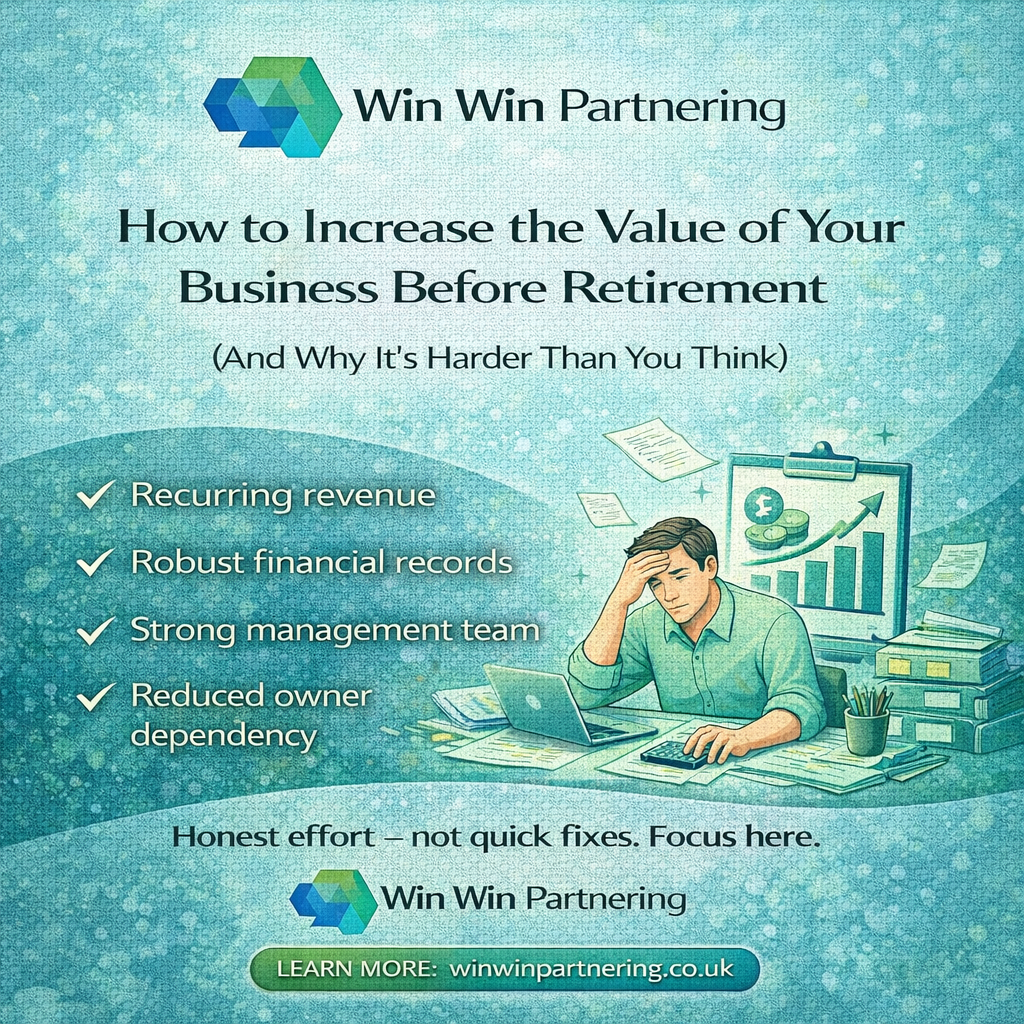
How to Increase the Value of Your Business Before Retirement
If you’re thinking about retirement, one question quickly becomes central:
How much is my business really worth and can I increase that value before I step away?
The honest answer? Yes, you can increase the value of your business. Improving valuation requires deliberate change, financial discipline, and often a few uncomfortable decisions.
First: Understand What Buyers Actually Pay For
Most owners assume buyers value effort, loyalty, or history. They don’t. Buyers pay for:
- Predictable profit
- Transferable systems
- Reduced risk
- Growth potential
If your business depends heavily on you personally, the value drops…no matter how successful it feels today!
Why Increasing Value Takes Time
You can’t “polish” a business in the final six months before retirement and expect a major uplift in price. Valuation improvements often require:
- 12–36 months of consistent financial performance
- Cleaner reporting and forecasting
- Removing inefficiencies
- Reducing dependency on the owner
It’s not about surface-level adjustments, it’s structural work.
The Hard Truth: Most Value Is Lost in the Details
Small issues compound:
- Informal processes
- Undocumented client relationships
- Over-reliance on personal goodwill
- Weak cash flow management
Individually, they seem minor. Collectively, they reduce sale price significantly. Fixing them means:
- Creating documented systems
- Delegating authority
- Letting go of control
- Making your role less essential
And for many founders, that’s the hardest part.
The 5 Areas That Most Increase Value
If you want to increase business value before retirement, focus on these top 5 areas. Each takes time and discipline to build.
1. Recurring Revenue: Predictable income commands stronger multiples.
2. Clean Financial Records: Three years of consistent, transparent accounts build buyer confidence.
3. Management Structure: If everything runs through you, the business is harder to transfer.
4. Clear Growth Path: Buyers want opportunity, not just stability.
5. Reduced Owner Dependency: The less the business relies on you, the more attractive it becomes.
The Emotional Challenge
Increasing value often means:
- Doing work you won’t personally benefit from long-term
- Investing in improvements shortly before stepping away
- Accepting that the business must operate without you
It can feel counterintuitive, but retirement planning is about maximising long-term outcome and not short-term comfort.
When Should You Start?
Ideally, 2–3 years before your intended retirement date. This allows you to:
- Strengthen profit
- Reduce risk
- Improve valuation multiples
- Explore sale or structured acquisition options calmly
A More Strategic Alternative
In some situations, instead of a traditional sale, structured acquisition or transition models may allow:
- Continued income over time
- Reduced stress
- Smoother transition
- Preservation of your legacy
For the right businesses, this can provide financial security without the pressure of a rushed open-market sale.
Final Focus
Increasing the value of your business before retirement isn’t about cosmetic change. It’s about:
- Discipline
- Systems
- Letting go
- Planning early
It takes effort. But when done properly, it can significantly improve your retirement position.
If retirement is on the horizon and you want an honest assessment of where you stand (and what would realistically increase value) a confidential conversation can help you understand your options.
👉 Start here: https://winwinpartnering.co.uk/contact/